
Step out of the Rain: Author Alison Irvine on Simple Minds and the Rebirth of the Barrowland
Big thanks to author Alison Irvine who has shared this lovely long read from her new book Barrowland: The inside story of Glasgow’s beloved ballroom. In this excerpt Alison chats to Lesley and Howard who were lucky enough to win tickets to see Simple Minds film the ‘Waterfront’ video at Barrowland, and the man who drew the ballot and posted out every single ticket, Billy Sloan. The rest is history…
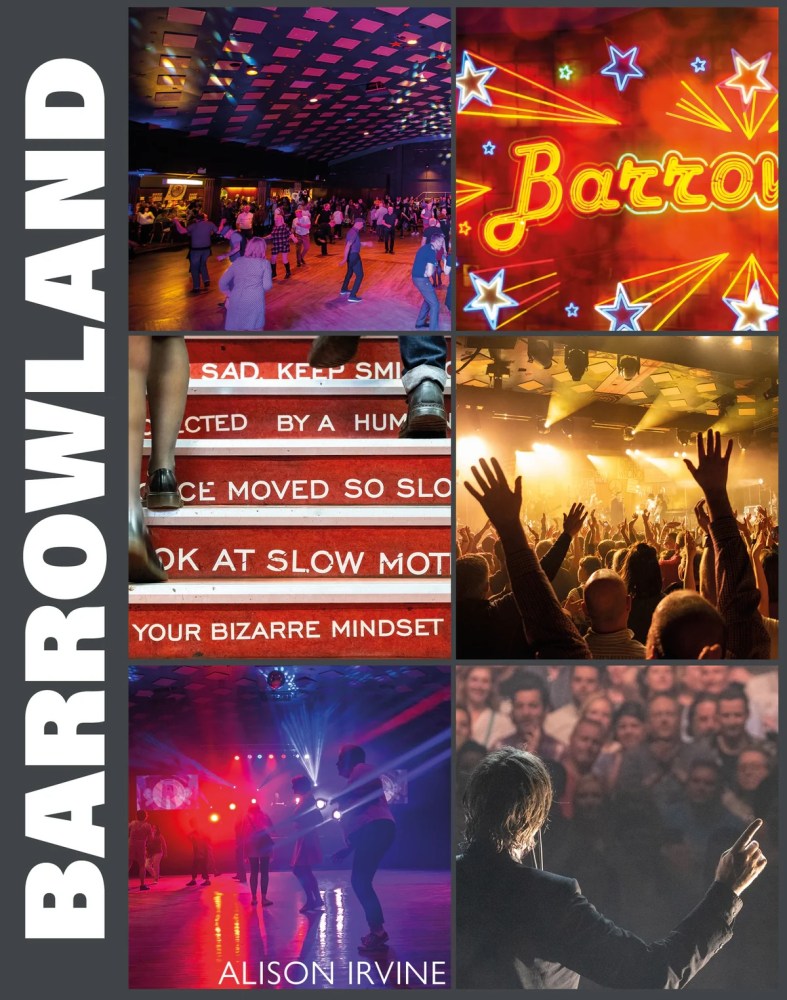
Barrowland: The inside story of Glasgow’s beloved ballroom by Alison Irvine
An anything-is-possible moment by Alison Irvine
That Simple Minds day really was a standout day in my life. You went home, your mum was like ‘How was your day?’ and you were like ‘That was life changing.’ Lesley Jones, Journalist
In the opening frames of Simple Mind’s ‘Waterfront’ video, shot at the Barrowland Ballroom on 20th November 1983, a man walks slowly across the Barrowland dance floor to the sound of insistent, rhythmic clapping. He kicks an empty cup, one of many that are scattered on the floor. The clapping quickens to enthusiastic applause and the video cuts to smiling faces, outstretched arms and waving hands. A second later, explosive drums and guitar kick in and then the video alternates between the lone figure on the dance floor and the wild, kinetic crowd at the gig. After a few more seconds there is a wide-angled shot of the Barrowland stage. Crossing white spotlights frame drumkit, keyboards, microphones, guitars. Billy McGregor’s acoustic ceiling tiles are lit up and three mirror balls sparkle in the light. On the dance floor, a thousand bodies are turned towards the stage where the Simple Minds musicians play.
Undoubtedly the star of the video is the crowd and the way the young people reach towards the camera, clamouring to be filmed, or lean onto the stage to touch singer Jim Kerr. Such manic, contagious energy. Even through the grainy video uploaded to YouTube you can get a sense of the excitement. You want to be there, to be part of that crowd.
Lesley aged 14 and Howard aged 22 are in that crowd. Lesley is squashed at the front next to the runway stage on the side of Mel Gaynor’s drumkit, because she loved his drumming. And Howard? He is towards the back somewhere, but he couldn’t tell you exactly where he is because it was over 40 years ago. He still has his ticket, though.
The tickets are an important part of this Barrowland story because they were given away for free by music journalist Billy Sloan on his late-night Thursday show on Radio Clyde, and Lesley and Howard were lucky enough to win one.
I speak with Lesley, Howard and Billy about this auspicious day at the Ballroom. What strikes me as much as the facts – Jim Kerr’s suit was blue, the Minds played a live set as well as recording video footage for their single, the event kickstarted a run of gigs at the Barrowland that has yet to stop – is the variations in recollection that the three of them have; what they remember and what they don’t. I’m also interested in how, in small and momentous ways, being present at the filming that day has affected their lives.
I talk with Howard in a cafe in the Barras, with every table around us full with lunchtime diners and a queue of people waiting at the counter for takeaways. In 1983 he was 22 and the first person from his family who had been to university. He was unemployed and battered by job rejections. Between then and now he has circled the globe in pursuit of gigs and finely crafted beer.
I interview Lesley over Zoom. She has retained a bemused fondness for the seasoned gig-goer she was at 14, mad about music, clothes and hair gel. She’d already been to many gigs at the Apollo with her mum who was a social work assistant and was often given free tickets for the young people she worked with.
Billy worked in a shoe stall in the Barras when he was a teenager and started out as a journalist on the Springburn and Bishopbriggs Gazette. We’re in his Glasgow flat and he’s looking after his neighbour’s poorly dog who sits next to him on the settee and barks meekly from time to time.
So, the tickets.
Billy Sloan’s show ran from midnight to two. ‘I used to sit with a bunch of my favourite records and play them,’ he tells me. ‘I naively took the point of view that I think these are great records; maybe somebody else will think they’re great records too.’ He’s on the money there; Howard and Lesley were fans of his show.
As he regularly played Simple Minds records and the band had guested on his programme, he tells me the manager of Simple Minds, Bruce Findlay, said to him, ‘We need an audience. How do you fancy giving the tickets away?’ The dog barks. ‘What is it, sweetheart?’ he says to the elderly dog.
Howard had been unemployed for 18 months. Dozens of job applications and no offers. Not a sniff. He’d lost weight. ‘I was going downhill a bit,’ he tells me. ‘I’d done an MSc in Tourism and an MSc in Urban Planning. I’m from a working-class family. I’m of that generation where we were encouraged by our parents to go to university. So I’d studied hard, applied for everything and got nowhere.’ But music was a distraction. Billy Sloan’s late-night show, in particular. ‘Billy always used to play an interesting range of music,’ Howard says. He heard Billy’s call-out for audience members one Thursday evening.
‘Was it 1983?’ Lesley says as we talk over Zoom. She moved from her home in Glasgow to London several decades ago. I see her trying hard to remember the details and she seems as enthusiastic and overcome by the whole thing as I imagine she was as a teenager. ‘It would have been a show like Billy Sloan,’ she says. ‘Something alternative. But when I think about it, it may have been a more mainstream show on in the day.’
She was right first time.
Howard confirms. ‘Billy said that Simple Minds want to record live concert footage for a video they’re doing. And he said they’re looking for an audience. We’re giving away free tickets and if you get a ticket come along and be part of the audience for the recording.’
Billy asked listeners to send in a stamped addressed envelope to be one of 500 (‘Or was it 750?’ he asks) to receive a pair of tickets to the filming on 20th November 1983 at an unknown location. That location was the Barrowland Ballroom.
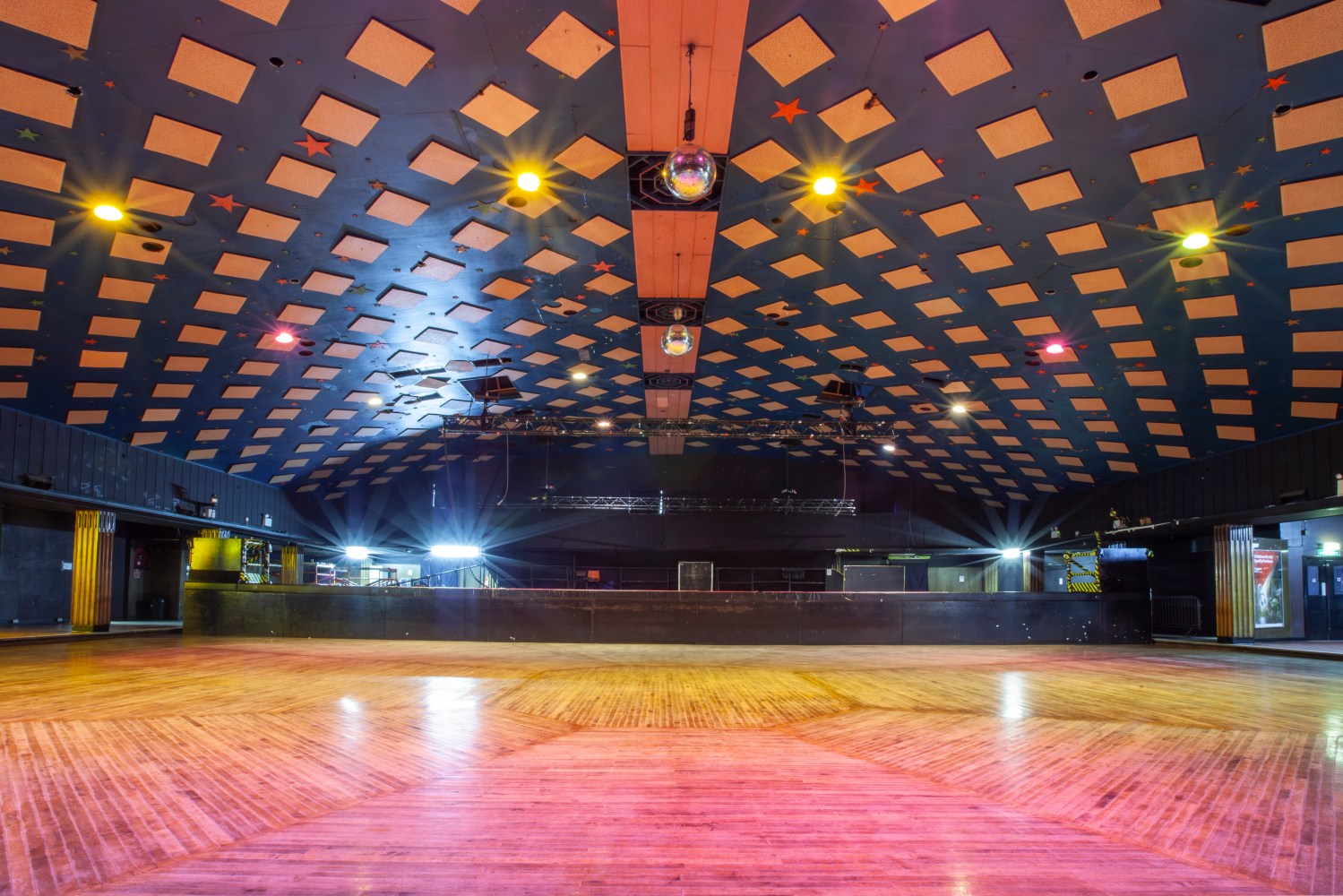
Barrowland Ballroom by Chris Leslie
Howard and I are drinking coffees and eating filled rolls. I’m firing questions at him and he’s talking more than he’s eating but he does show me photographs of Nanci Griffith and Emmy Lou Harris from the times he’s met them before or after their gigs.
Until that point, the Barrowland Ballroom was empty. Occasional roller discos had taken place, including one in which a 12-year-old girl, Maria, had her birthday party (they used to get changed in what is now the main band dressing room) and before that there was the disco dancing in the 1970s, but there was none of the regular music and dancing that used to take place on weeknights and weekends. No live music. The Ballroom was a working venue, but dormant and dark.
I speak with Dugald McArthur, whose great-grandmother was Maggie McIver (his mother was the daughter of Margaret McIver’s daughter, Kitty Cairns). When he was a boy his family emigrated to Canada and, as a way of pacifying his bereft Glasgow family, his mother brought him back to Glasgow every summer and he spent his weekends helping his uncle Victor in the Barras and his weekdays helping his grandmother in the Ballroom.
‘What if the Waterfront video had not been done?’ he asks me. ‘Would this ever have happened?’ It’s quite the question.
Dugald remembers a directors’ meeting to discuss the proposal to record the video. His grandmother’s office was upstairs on the same level as the dance floor. He would sit with her on quiet days but he wasn’t allowed upstairs while that particular meeting took place.
Speaking to me as the firm’s managing director and not the boy barred from the Ballroom, he understands the considerations his predecessors would have given the proposal from Simple Minds’ team. ‘For us at the time it was rental income,’ he tells me. ‘I never heard anyone say definitively that that was part of a plan. I think what it became was an opportunity – and that’s what the business has done for years is seized an opportunity.’
So, ‘the comets crossed, the planets aligned,’ Dugald says. Kitty and the directors said yes to the filming of the video. ‘And then it became history.’
In 1983 Billy Sloan finished his evening show and took bin-bags of stamped addressed envelopes to the Radio Clyde canteen. ‘We got thousands of people,’ he tells me of the number of applicants. ‘It was like the Blue Peter appeal. Maybe five, six or seven of these bin-liners filled to the brim. I thought, Christ, how are we going to do this?’
One at a time. He picked them out with his colleague, Ross King. They sat in the canteen from two in the morning when his show finished until sunrise, picking out envelopes, opening each one up, taking out the stamped addressed envelope and putting two tickets inside. Despite having had no sleep, Billy and Ross were savvy. They watched out for multiple names at the one address. Bob Burns, Billy Burns, Brendan Burns, Brenda Burns. They didn’t want to give extra tickets to someone when hundreds – thousands – of people would miss out. In amongst those envelopes were tickets for Howard and Lesley. Then, he says, ‘I walked along to George Square where the big main post office was and I stood at six in the morning when folk were going to their work and I physically posted them through the letter box.’ One by one. Off they went to their recipients.
‘It was like Willy Wonka,’ Howard says. ‘Not a golden ticket but a silver ticket. “Turn up at the Barrowland, Sunday afternoon, for the filming of Waterfront.”’ He corrects himself. ‘The filming of a video. It didn’t say Waterfront.’ Until then, few people had heard the song: not Howard, not Lesley, not even Billy.

Howard’s invitation
Lesley tries to remember what she wore. ‘I think I had jeans on and my favourite blue mohair jumper. And my hair as crazy as I could get it.’ She’d shaped it into spikes with her Country Born hair gel. Howard? Who knows what Howard wore, he can’t remember. ‘Probably a T-shirt. But maybe something fairly warm because it was November.’
It was November, yet Lesley remembers the sky being a brilliant blue while she waited in the queue outside. She had never been in the Barrowland Ballroom before but she’d heard of it. Lesley had been friends with twin girls whose grandpa was Billy McGregor who sang with his band, the Gaybirds, in the Barrowland back in the day. (Remember the ceiling tiles that stand out so clearly on the video? It was Billy McGregor who’d asked for them to be installed to enhance the acoustics.) She’d got on well with the girls’ mum, Ray, who used to tell them stories about her daddy and the band and the Barrowland. Lesley’s dad knew of the Barrowland, too, being a policeman. But apart from this, there was no significance about standing outside the Barrowland Ballroom on a sunny winter’s day, about to go in. ‘I don’t remember feeling excited that I was going to get inside Barrowlands for the day,’ she says. ‘I was excited about possibly being on the telly and seeing Simple Minds.’ So she waited in the queue with her pal on this blue day. It was one of her first gigs without her mum.
And Howard waited, too. He went on his own, less bothered about getting on the telly, and more bothered about seeing Simple Minds. ‘Oh, I was a fan!’ he says. ‘I absolutely loved them and I thought they were brilliant. I first saw them when they were Johnny and the Self Abusers.’ He, too, knew of the Barrowland Ballroom. He knew of its past and he was a fan of the Barras market. He tells me he used to come for a look around. ‘Pick up a bootleg. Go to the cafe. You never know what you’d find. It was such a great place.’
Waiting in the queue outside the Ballroom, he spoke with the people next to him. ‘We all considered ourselves quite lucky we’d got a ticket.’
Billy, meanwhile, was in the dressing room with Simple Minds. He’d spent the previous day, a Saturday, filming on the Renfrew Ferry with the band. (If you watch the video you’ll see that the Barrowland footage is interspersed with shots of the River Clyde and the band on the ferry.) He’d never been to a video shoot before the ‘Waterfront’ shoot and he’d never witnessed a recording with a live audience. I ask him if he spoke to the crowd in between takes, to keep them entertained during the breaks in filming. Perhaps, he says.

Barrowland Ballroom Dressing Room. Photo by Chris Leslie
Lesley tells me she liked Simple Minds’ music. She was of the same tribe as other music fans in Glasgow, those of the black-walled bedrooms, the ripped-up jeans, the painted T-shirts, the spiked hair. Simple Minds’ music belonged to that tribe. She and Jim Kerr went to neighbouring schools – hers King’s Park and his Holyrood (although he was nine years older than her) – and there was something exciting about living near him, about being from the same part of the city as him. Close enough to pass on the street if the comets and the planets aligned.
When the Simple Minds video crew was ready, Lesley and Howard were let into the Barrowland. They climbed the first set of stairs with doors leading to the area we call the Crush with the merch stand and toilets and Revue Bar off it, and then up the stairs to the ballroom. Which set of swinging double doors they went through we don’t know, but they’ll have walked into the ballroom with the other people and stepped onto the Maplewood floor with its stage prepped and ready for a gig, albeit a manufactured one.
‘The mirror ball is what I remember,’ says Howard. ‘I just have a general picture of this big open venue, the slightly higher stage, Simple Minds all set up.’
‘I remember sprinting to the front, getting squashed against the stage and hardly being able to turn round to get a good look at the place,’ Lesley says. ‘It certainly wasn’t very razzamatazzy from what I could see. It seemed to me very dull and black. And the catwalk thing we were squashed up against was just kind of black painted plywood. Nothing fancy.’
‘Wow. This is amazing,’ Howard thought when he walked into the ballroom. ‘The equipment was set up on the stage and they had a thing down the centre with the audience each side.’ Immediately, he saw the Ballroom’s potential as a gig venue. ‘Why do we not know about this place? This is a great venue,’ he remembers people saying to each other.
Lesley and her friend Lauren picked a spot at the front. ‘It was set out with a stage and the drums were off to one side. The side I was on, I could get quite a good look at Mel playing drums. He was my focus because I always thought he was an absolutely brilliant drummer. I still do.’ Howard chose a spot further back where it was less crushed and he felt, at last, at home. ‘Like-minded souls’ is how he describes his fellow audience members. Job applications, unemployment, mental fatigue – they could all disappear for a few hours while the band played.
Lesley says, ‘There was good humour between everybody. It was just chaos. Fan adoration. There wasn’t like all the cool kids standing about going “Oh right, are we going again?” It was like “Raaaaahhh!” It was a rammy.’ We talk about the video and she says, ‘You can see how squashed everyone was. I mean the health and safety nowadays would have gone crazy. We must have been in there for hours. I’m five foot ten. My pal Lauren who was with me was up to my shoulder. I’m surprised she didn’t faint. I do remember thinking Oh it’s been about four hours now since I had a wee. But I’m aint going anywhere!’
Here is where our facts and memories converge and diverge and overlap and contradict, and the beauty of this story is that it doesn’t really matter. The facts are that Simple Minds recorded the video for their ‘Waterfront’ single in the Barrowland Ballroom on 20th November 1983, Billy and Lesley and Howard were there, and after that the Ballroom went on to host gig after gig after gig. The rest, I guess, is legend.
Howard’s version: ‘Simple Minds came on and said we’re going to do scenes from the video but as a thank you, we’re going to play live for about an hour, an hour and 15. And they did. They played live.’
Lesley’s version: ‘I think they ran through it at least three times. We must have heard it three or four times, one after the other. They were filming it from different angles.’
Billy’s version: ‘Now the nature of video shoots is that you get herded about like cattle because they’re re-setting the lights and the camera angles. And even though the fans were diehard fans, after about eight times of hearing Simple Minds mime to Waterfront they were a bit fatigued. So, to offset that, Simple Minds said we’ll play a gig.’
Yes, but what came first? I ask Howard and Lesley and Billy, the live set or the video recording?
‘I wish I could remember, but it’s 42 years ago,’ says Howard, but then he says confidently, ‘The live set. Then there was a break and there was all the set-up for the cameras and stuff. If it hadn’t been for the live set at the beginning I’d have gone “Oh, bloody hell, this is a pain.”’
‘They did play a few songs afterwards,’ Lesley says. ‘It’s a sprung floor, isn’t it? The place absolutely jumped.’
So, the live set came after?
‘Yes,’ says Billy. The filming came first, the however-many run-throughs of the song from start to finish came first and then, he says, ‘They played a gig for an hour. They actually played live for an hour.’
And were they playing live for the video recording? ‘This is what I’m trying to remember,’ says Lesley. ‘The playback was really loud and the sound was immense. I remember feeling the drums go through my ribs. I was about three or four steps away from that drumkit. Was Jim Kerr miming? I don’t feel like he was. But he was obviously lip-syncing and with maybe a live overtrack. I don’t remember watching him and thinking Oh, this is like you doing a pantomime of a pop single. It felt live and direct.’
Howard? ‘They weren’t playing their instruments. Jim Kerr might have been singing but I’m not sure. I can’t confirm one way or the other.’
Billy? ‘From memory, it was a lip-sync, they were miming it,’ he says. After the filming of the video, he says, ‘I came onstage. I said, “Look, I’ve got a band in the back. They’ve never played the Barrowland before,” because nobody had at that time. And I said, “They’re a wee bit nervous. They want to play the Barrowland. So will you please welcome Mel Gaynor and the Self Abusers.”’ And, being the crowd they were, knowing their music, they would have known that Simple Minds had been called previously Johnny and the Self Abusers. ‘Of course, the cheer went up and on they came,’ he says.
And what was it like? What was it like to be in the crowd while the video was being filmed and during the live set, whichever came first?
‘The sound was amazing,’ says Howard.
‘The crowd played their part. They were kids, but they were diehards. And if you watch the video the crowd looks as if they’ve only done it once,’ says Billy.
‘The place went nuts,’ Lesley says. ‘Completely nuts.’ The floor bounced. Her ribs were squashed against the side of the stage. Her hair gel dripped down her back; her carefully tended spikes were flattened against her head. For hours, she stood there, screaming and reaching out to touch the band members, especially Jim, as he strutted past. Jim’s suit was blue. ‘It was his prancy kind of dancey stage. His tip-toey dancey stuff. He had weird white socks on and patent leather shoes. They looked like spats. He was like some hobgoblin.’ She says that everyone wanted to be on camera. ‘There might have been a guy with a camera going up and down, but it was on that ground level so he could get the faces. That’s why it was so crazy at the front.’ She remembers wondering if she would even like the band’s new song. ‘But you know, I did. I really did. Because it had that amazing beat that I’m always after.’
She says she looked around that day and saw people that looked just like her. ‘It was like going to church, in a way that I would understand, because I’m not religious. You felt at home and you had a sort of common something to worship, you know. And you felt the same things that those other people were feeling.’
So, just like Howard, she felt at home.
The band played it cool. They were at their work, after all. There was little chat between them and the fans in the audience. If there had been, Lesley imagines, there would have been a riot – all the kids in the crowd would have wanted to have been chatted to. So the musicians kept it cool and took it seriously and acted like rock stars.
And yet. Lesley felt a kinship between them and her, between band and audience. A fire was lit. ‘It did something to my brain that day,’ she tells me. It was something to do with everyone being from Glasgow. Something very democratic happened in the room. These young men on the stage – extraordinary rock stars – only a few years older than her but from a place and a background that was familiar to her and to many other people in the crowd.
‘Things are possible in Glasgow,’ she realised. If they could do it, so could she. ‘I remember thinking Oh, that’s what it’s all about. I’d always wanted to be a journalist and write about bands and I thought, Well, I could do that. He can be a popstar so I can be the person that writes about the popstars. It was an anything-is-possible moment.’
Empowering, I suggest, and she agrees. And not just because she saw people like her on the stage and in the crowd but also because of the manner in which she got her ticket. A free ticket in a free and fair ballot, picked out by the DJ himself, sent by post and landing on her doormat. No money exchanged. All for the price of two stamps and two envelopes. No waiting lists, no guest lists, no ‘Who’s got the richest mum and dad or who can click on the link first?’ she says. A room full of ‘working-class kids just like me everywhere I looked.’
She left the Barrowland Ballroom that day hot and sweaty, with her mohair jumper tied around her waist and her gel-soaked hair flat against her head, exhilarated, buzzing, steam coming off her as she walked out into the bright blue day. She questions the sunshine part of her memory. ‘Am I getting this right? Or was it such an amazing day that I’ve imagined it being fierce sunshine and freezing cold?’ Let’s let her have the stunning Glasgow weather, shall we?
‘That was a real seminal time for me,’ she says. She got her first boyfriend a week later. She went to dozens of gigs at the Barrowland after that. She didn’t study journalism, but she did eventually become a journalist. ‘My first big job was pop editor of Blue Jeans magazine.’ Her career took her to Mizz magazine and countless glossies and women’s weeklies and she has spent her life writing about music because on that day in November 1983 she believed that music journalism was a life she could have.
Howard continued to apply for jobs. ‘I tried everywhere. I got all these rejection letters and eventually they didn’t bother sending any because there were too many people applying.’ He got his first job soon after the ‘Waterfront’ video recording and was a town planner for 40 years, becoming branch secretary for Unison and the first elected convener of the RTPI (Royal Town Planning Institute) in Scotland. The pain and indignity of all those rejection letters he received when he was so young and so qualified but so unable to secure a job still affects him and he has always found solace in music. ‘I got lucky,’ he says. ‘I was of that generation. We got good music. We got an education. There’s a T-shirt: I may be old but I got to see all the good bands.’ His salary enabled him to travel the world to see bands and artists he adored – Nanci Griffith, King Gizzard and the Lizard Wizard to name two – and to return, of course, to the Barrowland Ballroom time after time, choosing a spot for several years by the main bar, downstage right, and in later years finding a better spot downstage left. ‘I just come in the front bit. There’s wee bits of space. Even with a big crowd, you still get gaps, and you can go in and stand and get some good pictures.’
‘You can escape to a different world with music,’ he says.
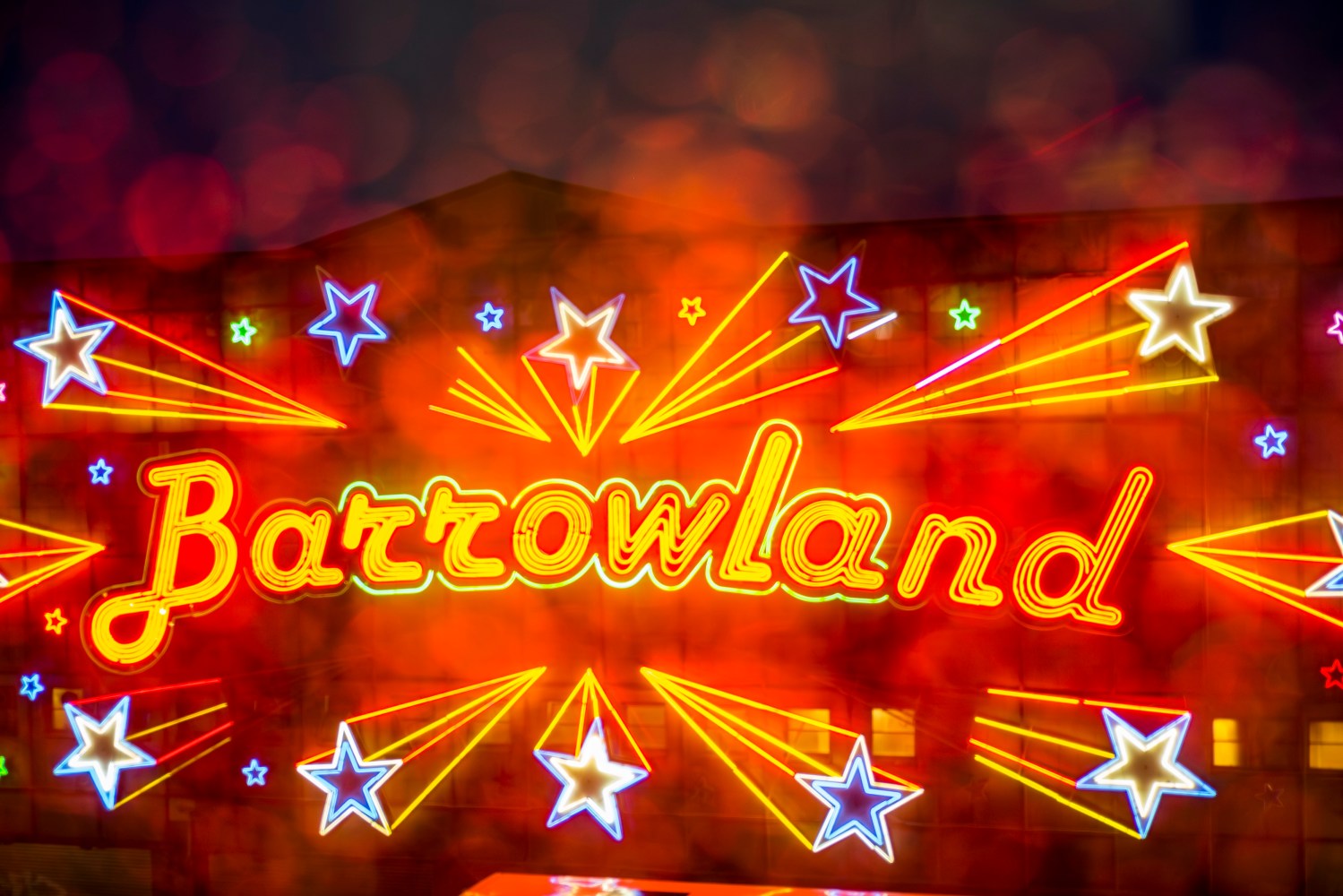
The Barrowland neon sign photo by Chris Leslie
After the ‘Waterfront’ video, promoters Regular Music began to use the Barrowland Ballroom as a gig venue for shows on any night of the week. Not just weekends but on weeknights too. ‘Regular Music did what it said on the tin,’ Billy says as we talk in his living room with the wee dog changing position from time to time on the couch or barking hoarsely for water before curling onto Billy’s lap. ‘Regular Music revolutionised how we went to see gigs in Scotland.’ Soon after the filming of ‘Waterfront’, Simple Minds were back to play three nights, then it was the turn of Big Country. In 1984 came The Clash, and Simple Minds again, Spear of Destiny, The Smiths, Siouxsie and the Banshees, The Cure, Aztec Camera, Depeche Mode, Echo and the Bunnymen, Grandmaster Melle Mel and the Furious Five, Level 42, Motorhead, UB40 and Marillion. Quite the year.
I like the idea of Billy Sloan, who now has a late-night Saturday slot on BBC Radio Scotland, a staunch supporter of Glasgow’s bands, a boy who worked at the Barras as a teenager, who taught himself to touch-type, who proved his journalistic credentials by working on the Springburn and Bishopbriggs Gazette, being the one who drew the ballot for the Simple Minds recording at the Barrowland, personally picking out the envelopes and posting them in George Square. It feels fitting.
And I like the idea of Barrowland’s Managing Director, Dugald, being adjacent to, if not witness to, that important meeting in the Ballroom between his grandmother Kitty, his uncle Victor and the Simple Minds management. A conversation which led to the filming of a video that would change the course of the Ballroom’s history and affect the lives of the young people in the audience that day. Billy, Howard and Lesley’s memories may converge and diverge but the planets and the comets on the day of that meeting crossed and aligned in a most spectacular way.
Barrowland: The inside story of Glasgow’s beloved ballroom is available from all good bookshops and Luath Press